
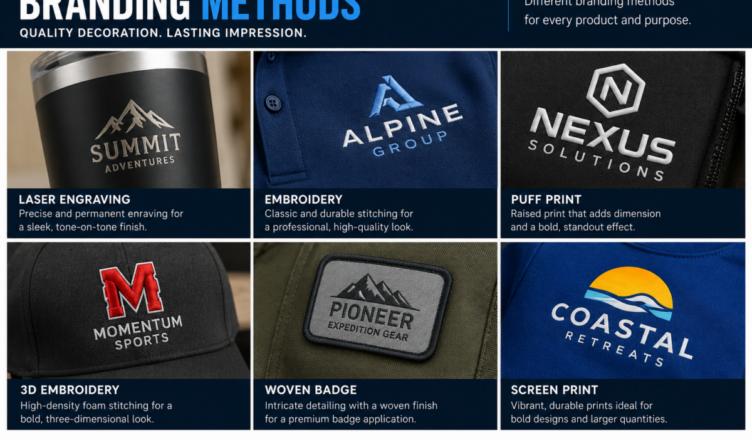
Promotional products have long been one of the most effective forms of marketing. Unlike digital advertising, which disappears with a click, or printed advertisements that are quickly discarded, promotional merchandise has the unique ability to become part of everyday life. A branded water bottle travels to the gym, a company hoodie becomes someone’s favourite weekend garment, and a premium notebook accompanies meetings for months or even years.
Yet the success of promotional merchandise depends on far more than selecting an attractive product. One of the biggest factors influencing how customers perceive your brand is how your logo is applied, so our complete guide to branding methods for promotional products is an invaluable resource for deciding which technique will work best on your project when paired with your branding strategy.
The same logo can appear completely different depending on whether it is embroidered, laser engraved, digitally printed or screen printed. One decoration method may communicate quality and craftsmanship, while another may be better suited to vibrant marketing campaigns or large-volume giveaways.
Choosing the correct branding method is therefore one of the most important decisions in any promotional merchandise project.
In this comprehensive guide, we’ll explore every major branding technique used throughout the promotional products industry, explain how each process works, and help you determine which decoration method is best suited to your products, audience and marketing objectives.
Whether you’re ordering ten executive gifts or ten thousand promotional giveaways, understanding these branding methods will help you maximise your investment and create merchandise people genuinely want to keep.
Screen Printing
The Industry Standard for Promotional Clothing
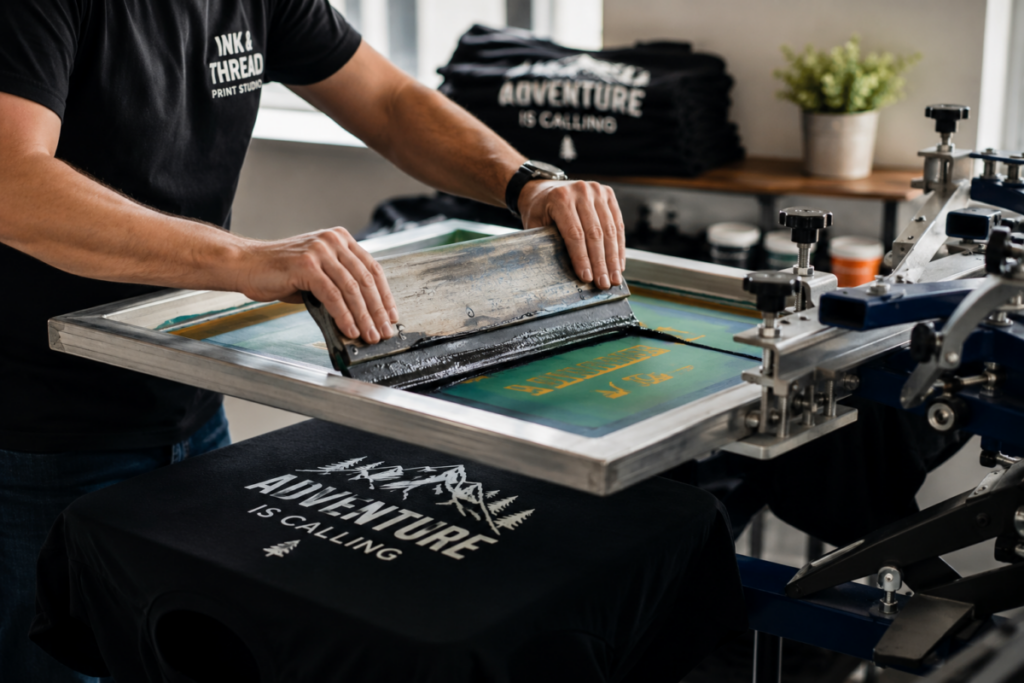
Screen printing remains one of the oldest and most widely used branding methods in the promotional merchandise industry. Despite the introduction of advanced digital technologies, it continues to be the preferred decoration method for large-volume clothing orders because of its outstanding durability, vibrant colours and excellent cost efficiency.
Rather than printing directly from a computer, screen printing uses finely woven mesh screens that allow ink to pass through selected areas onto the product beneath. Each colour within the artwork requires its own individual screen, making the process particularly effective for bold logos containing one to four solid colours.
Once printed, the garment passes through a high-temperature curing oven, permanently bonding the ink to the fabric.
This combination of simplicity, durability and efficiency explains why screen printing remains the preferred choice for promotional clothing, uniforms, event merchandise and branded retail apparel worldwide.
Best Products for Screen Printing
Screen printing performs exceptionally well on:
- T-shirts
- Polo shirts
- Hoodies
- Sweatshirts
- Tote bags
- Cotton shoppers
- Aprons
- Sportswear
- Cotton drawstring bags
- Fabric banners
Advantages
Screen printing offers several important advantages.
Outstanding Colour Vibrancy
Specialist inks provide excellent opacity and produce rich, vibrant colours, even on darker garments.
Exceptional Durability
When correctly cured, screen-printed garments withstand repeated washing while maintaining colour intensity.
Cost Effective at High Volumes
Although setup costs are higher than digital printing, the per-unit cost falls dramatically as quantities increase.
Pantone Colour Matching
Screen printing allows accurate reproduction of corporate brand colours using the Pantone Matching System.
This makes it particularly attractive for businesses with strict brand guidelines.
Limitations
Screen printing is not always the best solution.
Each colour requires its own screen, increasing setup costs.
Complex artwork containing gradients or photographic images often requires specialist four-colour process printing.
Very small production runs can become relatively expensive because setup costs are spread across fewer garments.
Best Suited For
Businesses ordering:
- 100+ T-shirts
- Corporate uniforms
- Event clothing
- Charity merchandise
- Festival apparel
- Retail-quality clothing
Expert Tip
For one or two-colour logos on cotton garments, screen printing remains one of the most economical and durable decoration methods available.
Pad Printing
The Perfect Solution for Small Promotional Products
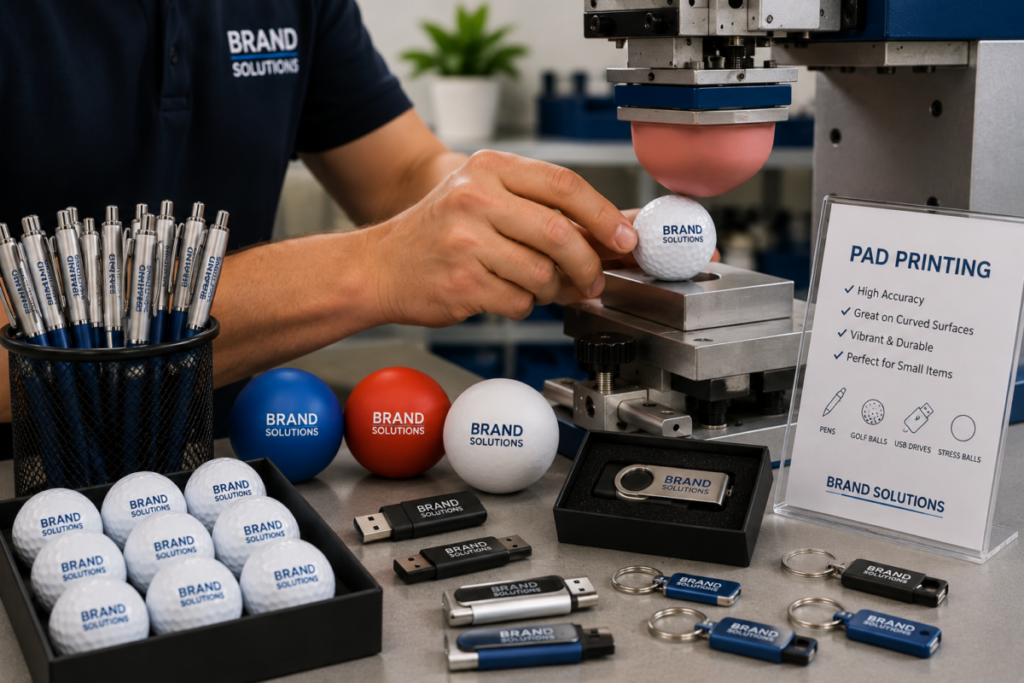
While screen printing dominates apparel decoration, pad printing is the preferred method for branding smaller promotional products with awkward or irregular shapes.
Instead of using a flat screen, pad printing transfers ink using a flexible silicone pad that conforms to the contours of the product.
This allows accurate printing onto curved, textured or uneven surfaces that would otherwise be impossible to decorate.
Ideal Products
Pad printing is commonly used for:
- Promotional pens
- USB memory sticks
- Keyrings
- Stress balls
- Golf balls
- Bottle openers
- Tape measures
- Plastic gadgets
- Phone accessories
- Small electronics
Advantages
Exceptional Accuracy
Pad printing reproduces crisp logos and fine text with impressive precision.
Works on Difficult Shapes
Curved, recessed and irregular surfaces can all be decorated.
Cost Effective
Ideal for high-volume promotional giveaways.
Fast Production
Modern automated machines can decorate thousands of products per day.
Limitations
Print areas are generally smaller than other methods.
Artwork is usually restricted to spot colours rather than photographic images.
Frequent handling may eventually wear the print on heavily used products.
Ideal Applications
Trade show giveaways
Conference merchandise
Promotional pens
Corporate gifts
Branded accessories
Full Colour Digital Printing
Unlimited Creative Freedom
Digital printing has revolutionised promotional product branding.
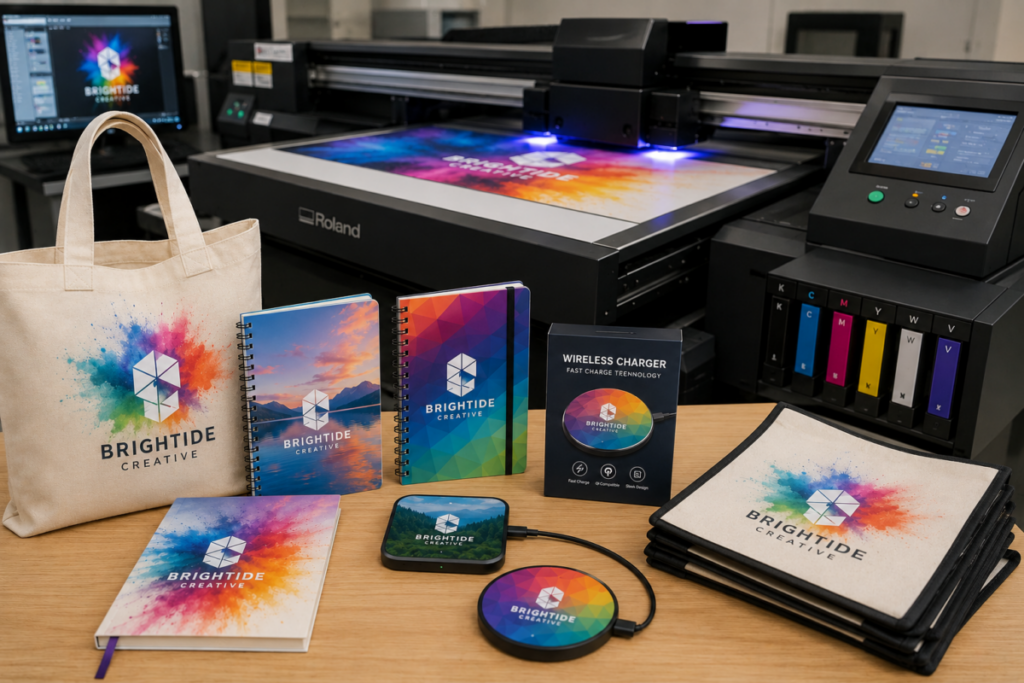
Instead of creating physical screens or printing plates, artwork is sent directly from computer to printer.
This allows unlimited colours, gradients and photographic-quality images to be reproduced quickly and accurately.
Unlike traditional printing methods, setup costs are minimal, making digital printing highly economical for smaller production runs.
Suitable Products
Digital printing works particularly well on:
- Notebooks
- Mouse mats
- Packaging
- Presentation boxes
- Power banks
- Wireless chargers
- Coasters
- Acrylic products
- Flat promotional gifts
Advantages
Unlimited colours
Photographic quality
No screen charges
Fast setup
Excellent detail
Ideal for personalised products
Perfect for short production runs
Limitations
Not suitable for every material.
Some surfaces require specialist coatings.
Very large production runs may become slower than screen printing.
Best Applications
Marketing campaigns
Product launches
Corporate gifting
Small batch promotions
Full-colour artwork
UV Digital Printing
Instant Curing Technology
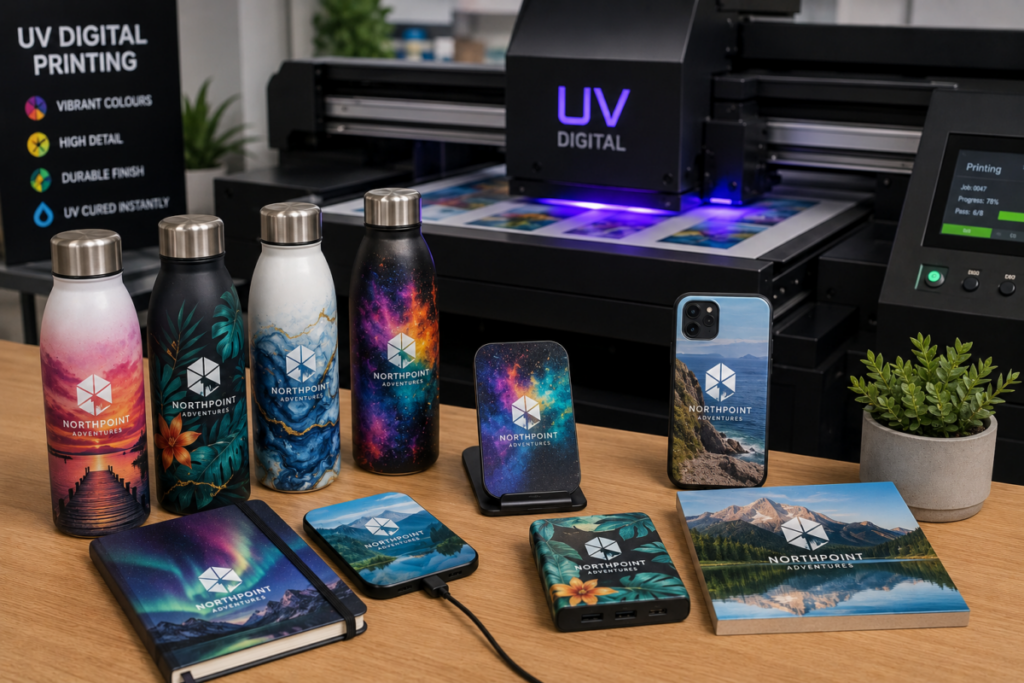
UV printing represents one of the most advanced decoration methods available today.
Special UV inks are applied directly to the product before being instantly cured using ultraviolet light.
Because the ink hardens immediately, colours remain incredibly sharp while reducing the risk of smudging.
The process also produces outstanding durability on many hard promotional products.
Best Products
UV printing is ideal for:
- Phone stands
- Wireless chargers
- Acrylic awards
- Metal tins
- Gift boxes
- Plastic products
- Drinkware
- Technology accessories
Advantages
Exceptional colour reproduction
Outstanding detail
Instant curing
Scratch resistant
Suitable for textured materials
Excellent adhesion
Supports variable data printing
Limitations
Requires compatible product surfaces.
Not every product material accepts UV ink equally well.
Expert Recommendation
If your logo contains gradients or photographic imagery, UV printing often produces superior results compared to pad printing.
Direct-to-Garment (DTG)
Retail Quality Garment Printing
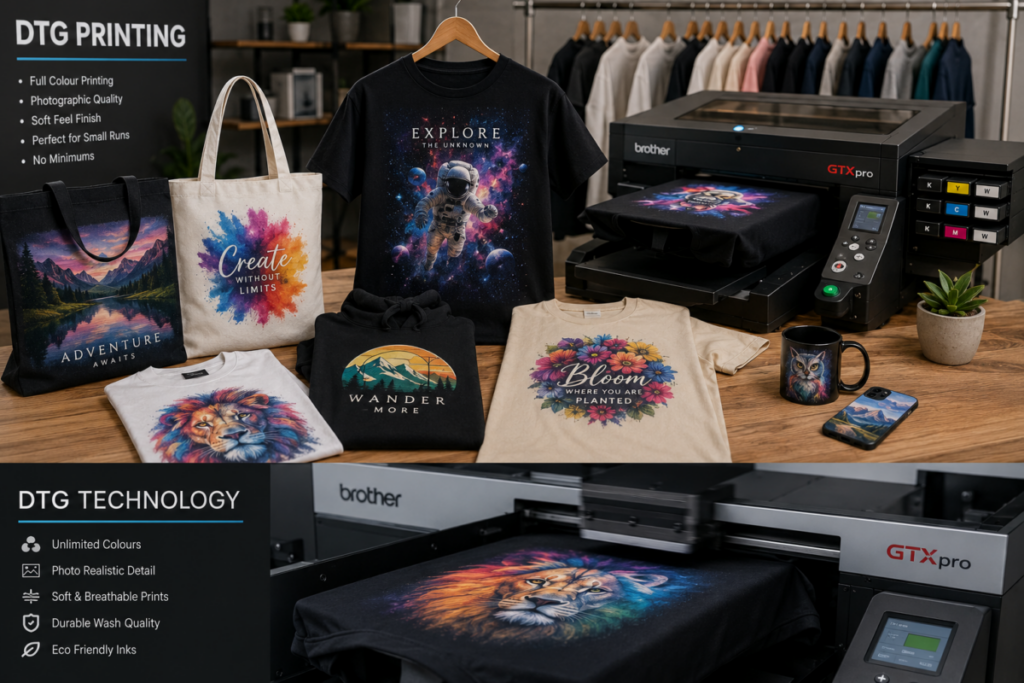
Direct-to-Garment printing, commonly known as DTG, prints directly onto fabric using specialist textile inks.
The technology functions similarly to an inkjet printer but is specifically designed for garments.
Unlike heat transfers, the ink soaks into the fibres, creating an exceptionally soft finish.
Best Products
Cotton T-shirts
Fashion garments
Organic cotton clothing
Retail merchandise
Premium promotional apparel
Advantages
Soft feel
Unlimited colours
Photographic images
Excellent detail
No setup costs
Ideal for small runs
Limitations
Works primarily on cotton.
Not ideal for large production runs.
Slower than screen printing.
Ideal For
Online merchandise stores
Employee clothing
Limited edition apparel
Retail-quality promotional clothing
Direct-to-Film (DTF)
One of the Fastest Growing Decoration Methods
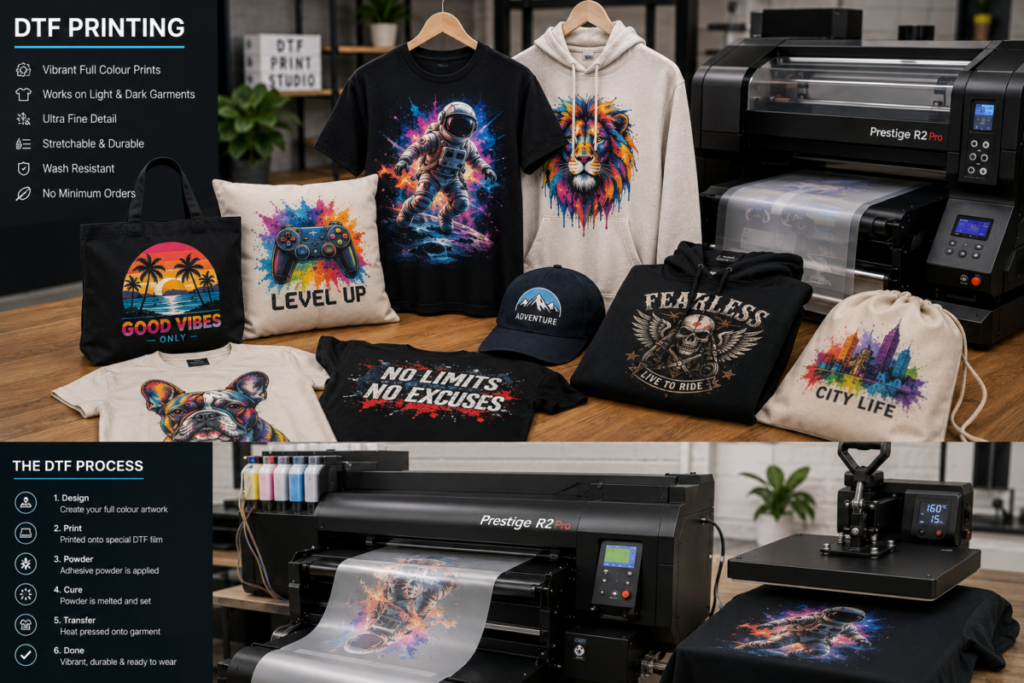
DTF printing has transformed garment decoration.
Instead of printing directly onto fabric, artwork is first printed onto specialist transfer film.
Adhesive powder is then applied before the transfer is heat pressed onto the garment.
The result combines vibrant colours with outstanding versatility.
Best Products
T-shirts
Hoodies
Polo shirts
Softshell jackets
Sportswear
Workwear
Cotton garments
Polyester garments
Mixed fabric clothing
Advantages
Excellent durability
Bright colours
Works on mixed fabrics
Minimal setup
Perfect for personalisation
Excellent detail
Suitable for smaller runs
Limitations
Slightly heavier feel than DTG. Requires professional heat application.
Heat Transfer Printing
Flexible and Highly Personalised
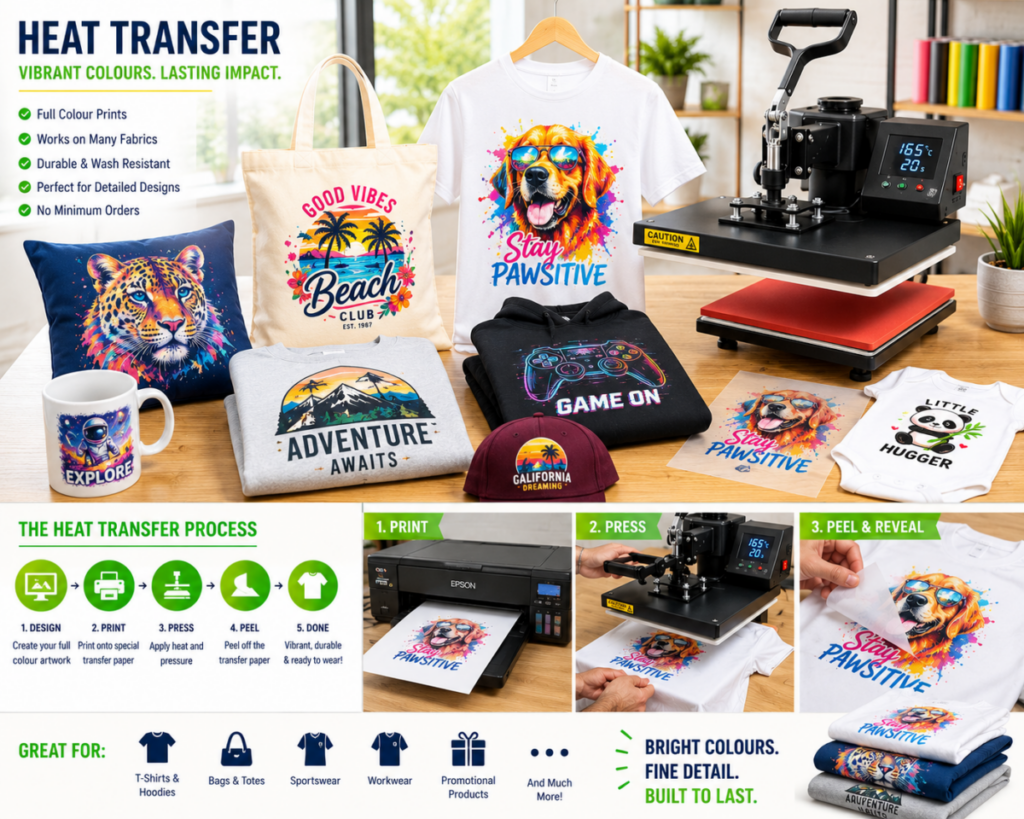
Heat transfer printing uses pre-produced artwork that is permanently applied using industrial heat presses.
Unlike screen printing, every garment can contain different artwork.
This makes heat transfer particularly valuable for sports teams, schools and staff uniforms.
Typical Applications
Sports shirts
Individual names
Numbers
High-visibility clothing
School uniforms
Corporate clothing
Promotional bags
Advantages
Easy personalisation
Excellent colour reproduction
Suitable for low quantities
Fast production
Ideal for variable data
Limitations
Can feel thicker than screen printing.
Application quality is critical.
Incorrect washing may reduce lifespan.
Dye Sublimation Printing
Permanent Full Colour Decoration
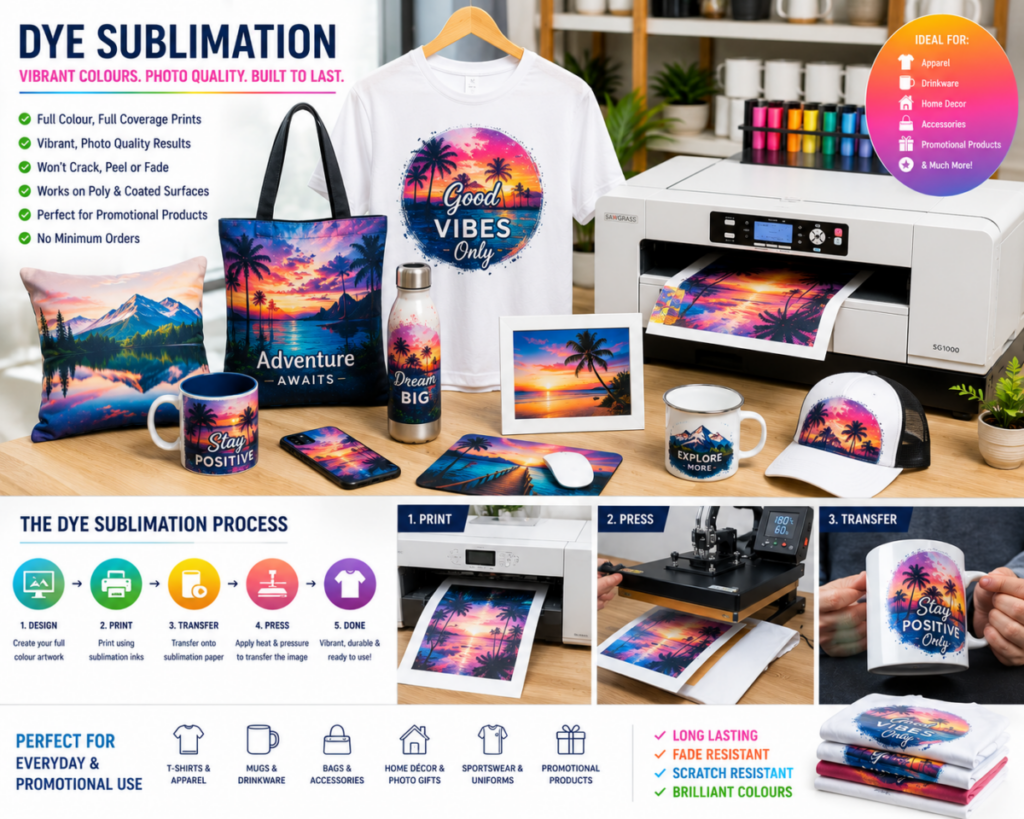
Sublimation is one of the few decoration methods where the ink actually becomes part of the product.
Instead of sitting on the surface, the ink transforms into gas during heating and permanently bonds with polyester fibres or specialist polymer coatings.
This produces incredibly vibrant, durable decoration.
Ideal Products
Sportswear
Football kits
Cycling jerseys
Running tops
Mouse mats
Lanyards
Ceramic mugs
Travel mugs
Drinkware
Advantages
Permanent decoration
Unlimited colours
Photographic quality
No cracking
No peeling
Excellent wash resistance
Soft feel
Limitations
Works primarily on white or light-coloured polyester.
Unsuitable for cotton garments.
Requires specialist coated products.
Best Applications
Sports clubs
Schools
Universities
Corporate events
Running events
Cycling events
Performance clothing
360° Digital Wrap Printing
Maximum Branding Impact
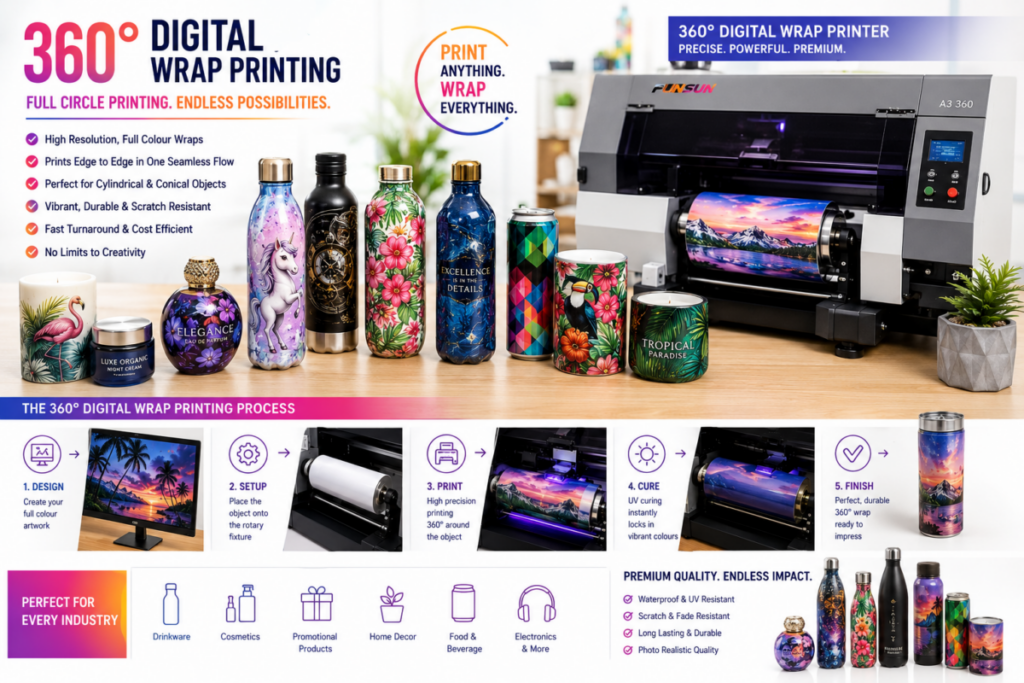
Traditional printing typically decorates only one side of a product. 360° printing changes this completely. Specialist rotary digital printers rotate cylindrical products while printing continuously around the entire circumference.
The result is seamless branding with maximum visual impact.
Ideal Products
Advantages
Maximum print area
Premium appearance
Outstanding shelf appeal
Unlimited colours
Wraparound graphics
Ideal for retail-style products
Limitations
Only suitable for cylindrical products. Artwork requires specialist setup.
Expert Recommendation
360° digital printing is rapidly becoming one of the most sought-after branding methods for premium drinkware because it transforms an ordinary bottle into a retail-quality branded product.
Comparing Printing Methods
| Method | Best For | Full Colour | Durability | Best Quantity | Premium Appearance |
|---|---|---|---|---|---|
| Screen Printing | Clothing | Limited | ★★★★★ | High | ★★★★☆ |
| Pad Printing | Pens & Gadgets | Limited | ★★★★☆ | High | ★★★☆☆ |
| Digital Printing | Flat Products | Yes | ★★★★☆ | Low-Medium | ★★★★☆ |
| UV Printing | Hard Goods | Yes | ★★★★☆ | Low-High | ★★★★★ |
| DTG | Cotton Clothing | Yes | ★★★★☆ | Low | ★★★★☆ |
| DTF | Mixed Garments | Yes | ★★★★★ | Low-High | ★★★★★ |
| Heat Transfer | Personalised Clothing | Yes | ★★★★☆ | Low | ★★★★☆ |
| Sublimation | Polyester Apparel | Yes | ★★★★★ | Medium | ★★★★★ |
| 360° Printing | Drinkware | Yes | ★★★★☆ | Medium | ★★★★★ |
Key Takeaways
There is no single “best” printing method for promotional products. The ideal choice depends on the product, material, artwork, order quantity, budget, and the impression you want your brand to make.
For bold, high-volume clothing orders, screen printing remains a dependable and cost-effective choice. Pad printing continues to excel on small, curved promotional items, while digital and UV printing provide outstanding flexibility for full-colour artwork and shorter production runs. DTG and DTF have transformed garment decoration, offering retail-quality results and greater versatility than ever before. For sportswear and polyester garments, sublimation delivers vibrant, permanent decoration, and 360° wrap printing has set a new standard for premium branded drinkware.
Choosing the right printing method ensures your promotional products not only look exceptional on day one but continue to represent your brand with quality and impact long after they have been distributed.
Embroidery
The Gold Standard of Corporate Branding
Embroidery remains one of the most respected and recognisable branding methods in the promotional clothing industry. It has been used for centuries to decorate garments and today continues to represent professionalism, durability and quality.
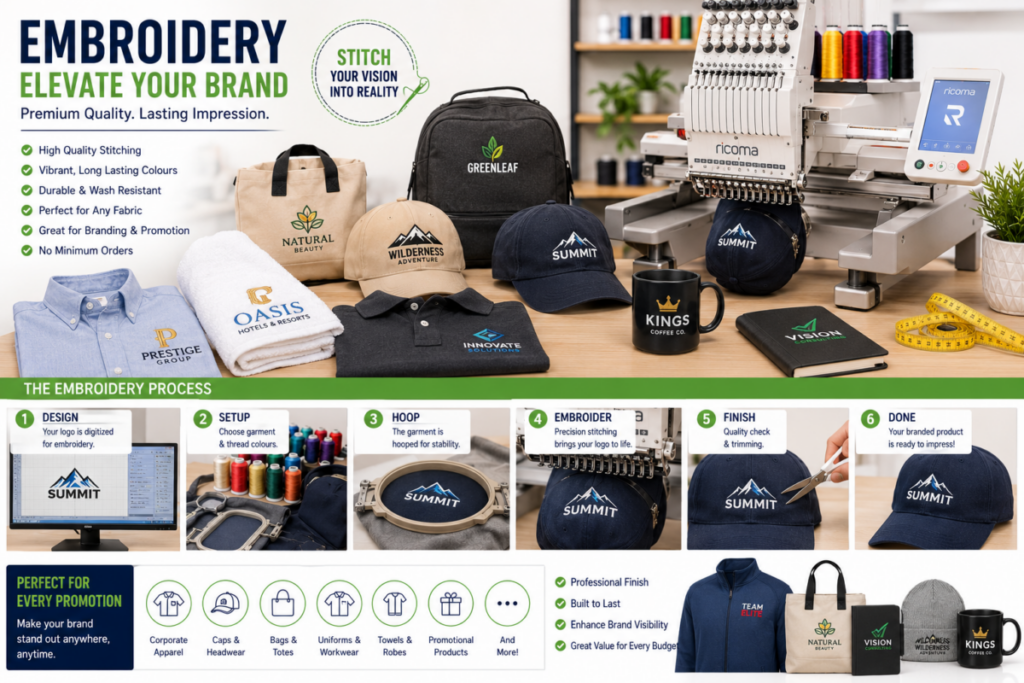
Rather than applying ink to the surface of a garment, embroidery stitches coloured threads directly into the fabric using sophisticated computer-controlled embroidery machines capable of producing thousands of stitches every minute.
The result is a premium finish that becomes part of the garment rather than sitting on top of it.
For many businesses, embroidery represents the benchmark for branded workwear.
How Embroidery Works
Before production begins, artwork must first be converted into a digital stitch file.
This process, known as digitising, tells the embroidery machine:
- stitch direction
- stitch density
- thread colours
- stitch types
- underlay stitching
- sequence
Unlike printing, embroidery cannot simply reproduce artwork pixel-for-pixel.
Experienced digitisers adjust designs to ensure they sew beautifully while maintaining the integrity of the original logo.
Good digitising is one of the biggest differences between average embroidery and outstanding embroidery.
Best Products for Embroidery
Embroidery works exceptionally well on:
- Polo shirts
- Hoodies
- Sweatshirts
- Fleeces
- Softshell jackets
- Waterproof jackets
- Corporate shirts
- Hi-Vis clothing
- Bodywarmers
- Caps
- Beanies
- Backpacks
- Laptop bags
- Towels
- Aprons
Advantages
Exceptional Durability
Embroidery is one of the longest-lasting decoration methods available.
Because the logo consists of stitched thread rather than ink, it resists fading, cracking and peeling.
Properly embroidered garments often outlast the clothing itself.
Premium Appearance
Thread naturally catches light differently from printed ink, creating depth and texture.
This immediately enhances perceived product quality.
Wash Resistant
High-quality embroidery remains intact after hundreds of washes when appropriate garments and stabilisers are used.
Professional Image
Embroidery is particularly suited to businesses wanting to project trust, expertise and reliability.
This explains why it is widely used throughout:
- Healthcare
- Hospitality
- Construction
- Manufacturing
- Financial Services
- Education
Limitations
Embroidery is not suitable for every design.
Very small text may become unreadable.
Complex gradients cannot be reproduced.
Photographic images are generally unsuitable.
Very large embroidered areas can become stiff and heavy.
Cost Considerations
Embroidery usually has:
- Digitising charge
- Stitch count pricing
- Quantity discounts
Although embroidery often costs more than printing, its longevity frequently provides better long-term value.
Expert Recommendation
If staff wear garments every day, embroidery almost always delivers the best balance between appearance, durability and professionalism.
3D Embroidery (Puff Embroidery)
Creating Logos That Stand Above the Crowd
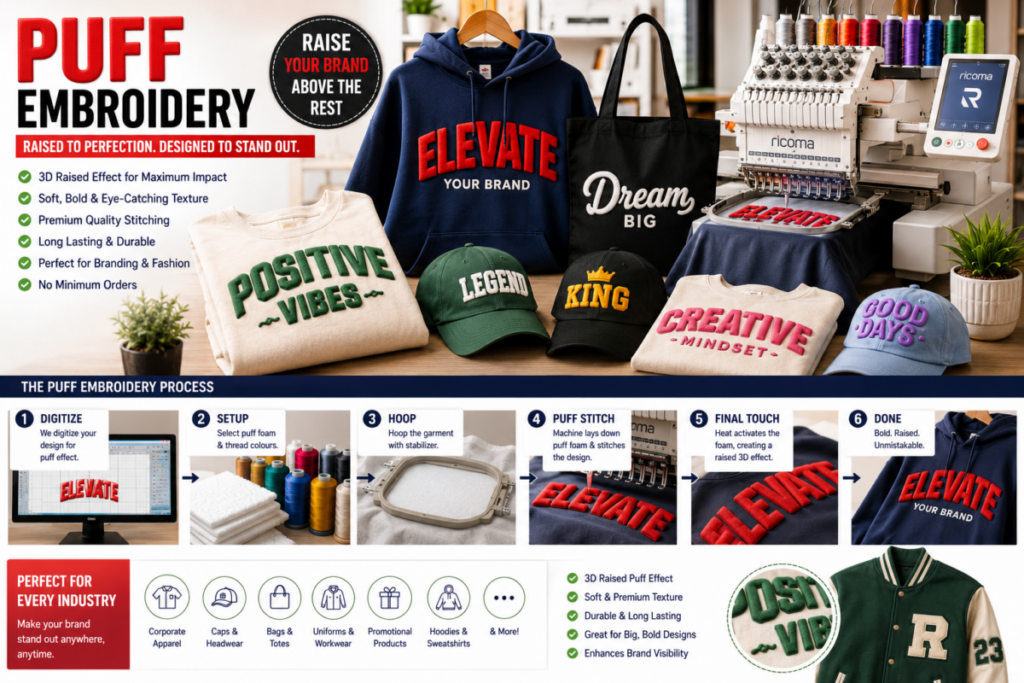
3D embroidery, often referred to as Puff Embroidery, is one of the most striking decoration methods available.
Instead of stitching directly onto fabric, specialist foam is placed beneath selected areas of the design.
The embroidery stitches compress the foam while creating a raised three-dimensional effect.
The finished logo literally stands proud from the garment.
Best Products
3D embroidery is commonly used on:
- Baseball caps
- Snapback caps
- Trucker caps
- Fashion hoodies
- Streetwear
- Sportswear
- Premium merchandise
Why Brands Love 3D Embroidery
The raised appearance immediately creates visual impact.
Many well-known sportswear and lifestyle brands use puff embroidery because it adds texture and retail-quality styling.
It has become synonymous with premium branded headwear.
Advantages
Outstanding visual impact
Premium appearance
Excellent durability
Highly tactile finish
Fashion-led styling
Creates depth
Perfect for bold logos
Limitations
Not suitable for:
Fine detail
Small lettering
Thin outlines
Photographic designs
Expert Tip
Keep puff embroidery simple.
Large bold lettering and strong shapes always produce the most impressive results.
Flat Embroidery vs 3D Embroidery
| Feature | Flat Embroidery | 3D Embroidery |
|---|---|---|
| Detail | Excellent | Moderate |
| Raised Effect | No | Yes |
| Premium Appearance | ★★★★★ | ★★★★★+ |
| Suitable for Text | Yes | Limited |
| Best Products | Clothing | Caps & Hoodies |
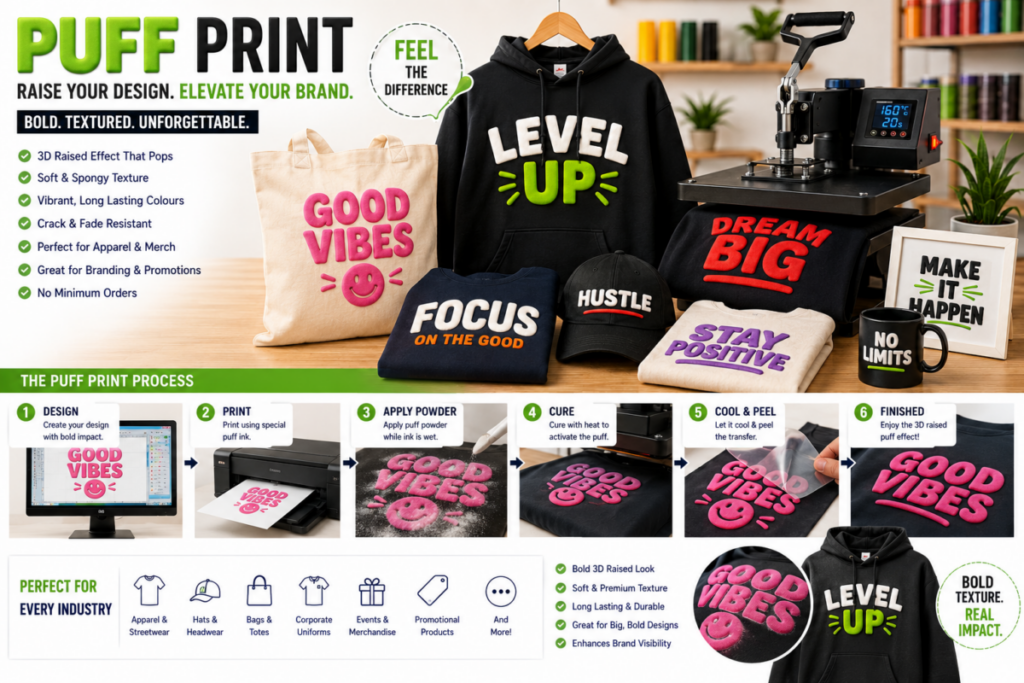
Puff Print
Raised Printing for Modern Fashion
Puff print is becoming increasingly popular within promotional clothing.
Unlike embroidery, puff print uses specialist inks that expand when heated.
The finished print rises from the garment surface, creating a soft three-dimensional texture.
It combines the colour flexibility of screen printing with the tactile qualities traditionally associated with embroidery.
Best Products
Hoodies
Sweatshirts
Fashion T-shirts
Streetwear
Lifestyle clothing
Retail-inspired merchandise
Advantages
Soft touch
Modern appearance
Excellent texture
Fashion-led styling
Works with bold graphics
Limitations
Best suited to larger artwork.
Not ideal for intricate detail.
Requires specialist inks.
Perfect For
Youth brands
Universities
Sports clubs
Lifestyle clothing
Retail promotions
Popular Applications
Luxury clothing
Fashion brands
Premium promotional garments
Corporate merchandise
Which Premium Branding Method Should You Choose?
| Decoration Method | Premium Appearance | Durability | Best For |
|---|---|---|---|
| Embroidery | ★★★★★ | ★★★★★ | Workwear |
| 3D Embroidery | ★★★★★+ | ★★★★★ | Caps |
| Puff Print | ★★★★★ | ★★★★☆ | Fashion Hoodies |
| Silicone Badge | ★★★★★ | ★★★★★ | Technical Clothing |
| PVC Badge | ★★★★★ | ★★★★★ | Sportswear |
| Woven Badge | ★★★★☆ | ★★★★★ | Beanies |
| Leather Patch | ★★★★★ | ★★★★★ | Outdoor Clothing |
| Chenille Patch | ★★★★★ | ★★★★★ | Varsity Apparel |
| Appliqué | ★★★★★ | ★★★★★ | Premium Garments |
Premium Decoration That Makes a Lasting Impression
Not every promotional product is designed to generate mass exposure.
Some are created to build relationships.
Others are intended to reward employees, thank loyal customers or celebrate business milestones.
These products demand a different approach to branding.
Rather than bright colours and bold graphics, executive gifts often benefit from subtle, sophisticated decoration that reflects craftsmanship, permanence and quality.
A laser engraved insulated bottle.
A debossed leather notebook.
A foil blocked presentation box.
An etched crystal award.
These products don’t simply display a logo—they become an extension of your brand identity.
Premium decoration techniques communicate professionalism, attention to detail and confidence without shouting for attention.
In this chapter, we’ll explore the branding methods most commonly used on executive gifts, premium drinkware, awards and luxury promotional products.
Laser Engraving
The Ultimate Premium Branding Method
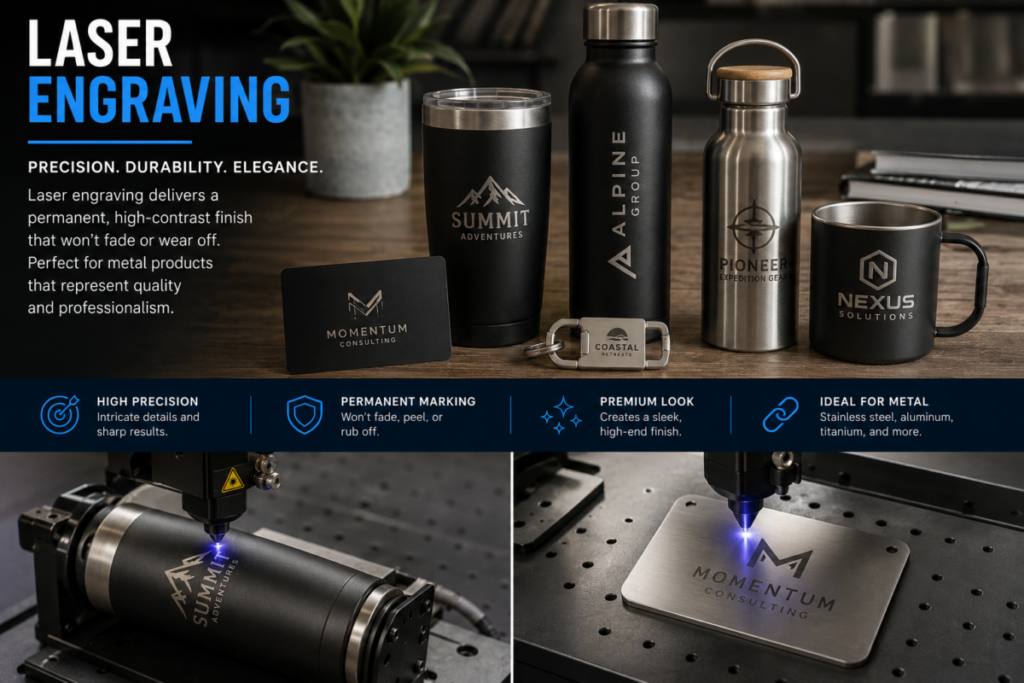
Laser engraving is widely regarded as one of the highest-quality decoration techniques available in the promotional products industry.
Unlike printed decoration, which applies ink onto the surface of a product, laser engraving permanently removes a microscopic layer of material using an extremely precise laser beam.
The result is a permanent mark that becomes part of the product itself.
Nothing can peel.
Nothing can crack.
Nothing can wash away.
For premium promotional merchandise, laser engraving remains one of the most desirable decoration methods available.
How Laser Engraving Works
Modern fibre and CO₂ laser systems are computer controlled.
The laser follows the vector artwork precisely while adjusting power, frequency and speed according to the product material.
Rather than burning the product, the laser carefully removes or alters the surface layer.
Depending on the material, this may produce:
- Silver engraving
- Black engraving
- White engraving
- Frosted engraving
- Natural wood engraving
- Tone-on-tone branding
This subtle appearance is one of laser engraving’s greatest strengths.
Best Products
Laser engraving is ideal for:
- Stainless steel water bottles
- Vacuum flasks
- Travel mugs
- Metal pens
- Executive pens
- Bamboo notebooks
- Wooden gifts
- Cork products
- Leather accessories
- Wine boxes
- Bottle openers
- Pocket knives
- Power banks
- Wireless chargers
- Awards
- Glassware
Advantages
Permanent Decoration
Laser engraving is one of the few branding methods that becomes part of the product.
There is no ink to wear away.
Premium Appearance
Minimalist branding often creates greater perceived value than large printed logos.
Luxury brands frequently favour subtle decoration.
Outstanding Precision
Modern laser systems reproduce intricate detail with exceptional accuracy.
Even fine typography remains crisp.
Environmentally Friendly
Laser engraving uses no inks, solvents or chemicals.
This makes it one of the more environmentally responsible decoration methods.
Highly Durable
Engraved branding easily withstands years of everyday use.
Limitations
Laser engraving does have limitations.
It cannot reproduce full-colour logos.
The final engraving colour depends on the base material.
Some plastics require specialist laser additives.
Expert Tip
Executive gifts almost always look more premium when laser engraved rather than printed.
Rotary Laser Engraving
Perfect for Cylindrical Products
Traditional laser engraving decorates flat surfaces.
Rotary engraving rotates cylindrical products while the laser engraves continuously around them.
This allows seamless decoration on:
- Bottles
- Tumblers
- Flasks
- Travel mugs
- Champagne flutes
- Wine glasses
- Metal cups
Why Rotary Engraving Is Popular
It allows larger branding areas.
Creates premium wraparound decoration.
Looks closer to retail drinkware.
Provides exceptional durability.
360° Digital Printing
Full Wrap Branding
Traditional printing often limits branding to one panel.
360° printing transforms an entire product into marketing space.
Using specialist rotary digital printers, artwork is wrapped around the complete circumference of the product.
This creates spectacular retail-quality results.
Best Products
Sports bottles
Travel mugs
Tumblers
Vacuum bottles
Protein shakers
Coffee cups
Advantages
Maximum branding area
Unlimited colours
Photographic quality
Retail appearance
Ideal for campaigns
Excellent shelf appeal
Limitations
Requires cylindrical products.
Artwork setup is more complex.
Premium production cost.
Ideal Applications
Corporate gifting
Retail merchandise
Sports clubs
Universities
Premium promotions
UV Rotary Printing
Combining UV printing with rotary systems produces outstanding full-colour decoration on curved products.
Unlike traditional wrap printing, UV inks cure instantly.
Benefits include:
Outstanding colour
Excellent durability
Gloss finishes
Matte finishes
Variable data printing
Premium quality
Deep Etching
Luxury Crystal Awards
Deep etching removes material from crystal using specialist engraving techniques.
The engraved areas refract light beautifully.
Commonly used for:
Corporate awards
Recognition trophies
Long service awards
Retirement gifts
Executive presentations
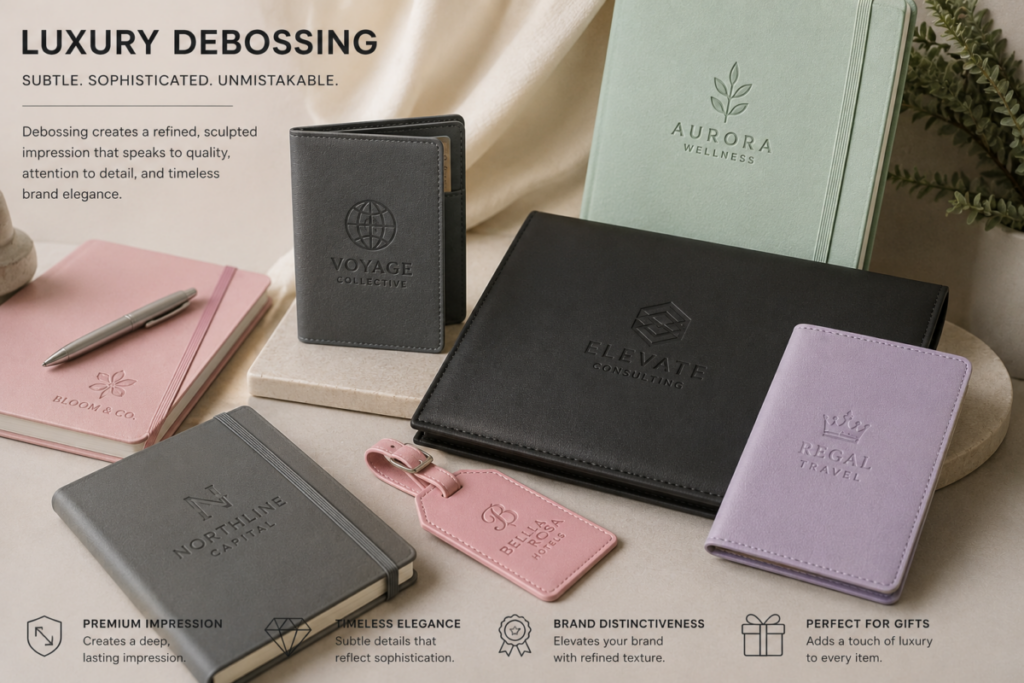
Debossing
Luxury Branding Through Texture
Debossing creates a recessed impression by pressing a heated metal die into the product surface.
Unlike printing, no ink is required.
Instead, the branding becomes part of the material.
Best Products
Leather notebooks
Executive diaries
Folders
Portfolios
Wallets
Passport holders
Gift boxes
Luxury packaging
Advantages
Sophisticated appearance
Excellent durability
Premium feel
Subtle branding
Long-lasting
Limitations
Limited to suitable materials.
Usually single-colour appearance.
Requires tooling.
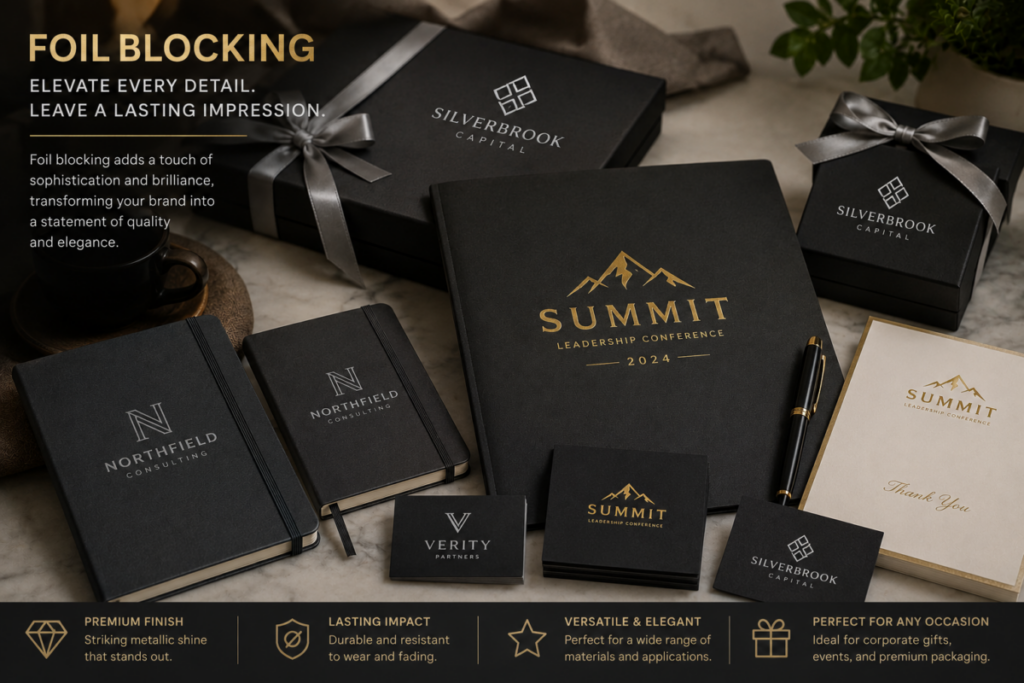
Foil Blocking
Metallic Luxury
Foil blocking combines heat, pressure and metallic foil.
The result is reflective branding that immediately attracts attention.
Available Colours
Gold
Silver
Rose Gold
Copper
Black
White
Holographic
Matte
Best Products
Presentation boxes
Luxury packaging
Certificates
Executive notebooks
Gift folders
Premium stationery
Advantages
Luxury appearance
Excellent shelf appeal
Strong brand visibility
Ideal for gifting
Combination Finishes
Many luxury products combine:
Debossing + Gold Foil
Embossing + Silver Foil
Laser Engraving + Digital Print
Embroidery + Silicone Badge
These hybrid decoration techniques produce exceptional retail-quality merchandise.
Best Products
Keyrings
USB drives
Power banks
Phone stands
Conference gifts
Technology accessories
Advantages
Excellent colour
Scratch resistant
Premium appearance
Water resistant
Creates depth
Luxury Packaging
Increasingly, businesses understand that presentation matters just as much as the product itself.
Luxury packaging may include:
Magnetic gift boxes
Foam inserts
Foil blocked lids
Ribbon closures
Printed tissue paper
Custom sleeves
Embossed logos
Branded thank-you cards
Premium packaging enhances the unboxing experience and reinforces brand quality before the recipient even sees the product.
Sustainability and Premium Branding
Premium decoration often aligns naturally with sustainability goals because it encourages recipients to keep products for longer.
A laser-engraved stainless-steel bottle or a debossed leather notebook is far less likely to be discarded than a cheaply printed giveaway. Durable decoration methods reduce the need for replacement and help extend the useful life of promotional merchandise.
Many premium products are now manufactured from sustainable materials such as recycled stainless steel, bamboo, cork, recycled leather and FSC-certified wood. Pairing these products with long-lasting branding methods creates promotional gifts that support both environmental objectives and positive brand perception.
Comparison Table
| Method | Best Products | Premium Appearance | Durability | Colour Capability |
|---|---|---|---|---|
| Laser Engraving | Metal, Wood | ★★★★★ | ★★★★★ | No |
| Rotary Engraving | Drinkware | ★★★★★ | ★★★★★ | No |
| 360° Printing | Bottles | ★★★★★ | ★★★★☆ | Yes |
| UV Rotary | Drinkware | ★★★★★ | ★★★★☆ | Yes |
| Debossing | Leather | ★★★★★ | ★★★★★ | No |
| Embossing | Packaging | ★★★★★ | ★★★★★ | No |
| Foil Blocking | Packaging | ★★★★★ | ★★★★☆ | Metallic |
| Doming | Tech Products | ★★★★☆ | ★★★★☆ | Yes |
| Sandblasting | Glass | ★★★★★ | ★★★★★ | Frosted |
| Deep Etching | Crystal | ★★★★★ | ★★★★★ | Frosted |
Choosing the Right Premium Decoration Method
The right premium decoration method depends on the product, the audience and the message you want your brand to convey.
- Laser engraving is ideal for executive gifts, drinkware and metal products where durability and understated elegance are key.
- Rotary laser engraving and 360° digital printing maximise the branding area on bottles, tumblers and travel mugs, creating a retail-quality finish.
- Debossing and embossing add tactile sophistication to leather goods, notebooks and presentation folders.
- Foil blocking enhances premium packaging and stationery with a luxurious metallic finish.
- Sandblasting and deep etching remain the preferred choices for crystal awards and commemorative gifts where prestige is paramount.
Ultimately, premium decoration is about creating products that recipients value enough to keep and use. When your branding complements the quality of the product rather than overpowering it, your promotional merchandise becomes a lasting ambassador for your business.
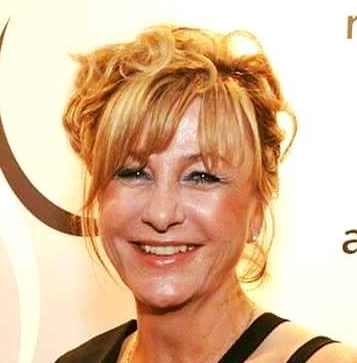
With 25 years experience running a screen print and print finishing organisation and currently 10 years in the promotional merchandise industry, Ann has an enviable reputation as a leading authority on branded merchandise and printed items. Her expertise ensures that she can identify and present the best branded merchandise to create an effective campaign for our customers requirements, offering innovative solutions for creative agencies and businesses alike.